Your marketing team presents open rates and MQL volume. Your CFO presents CAC, LTV, payback period, and pipeline coverage. Same quarter. Neither recognizes the other’s version of it.
This is a translation failure. In PE-backed and growth-stage B2B, it’s the failure that gets marketing budgets cut and CMOs replaced inside 18 months.
What your dashboard actually confesses
Most B2B marketing teams default to activity metrics: website traffic, impressions, email engagement, lead volume, campaign-level cost-per-click. These are operational metrics. They tell you whether a campaign ran. They don’t tell you whether the campaign created revenue, at what cost, or how fast that cost recovers.
Here’s the gap in one frame:
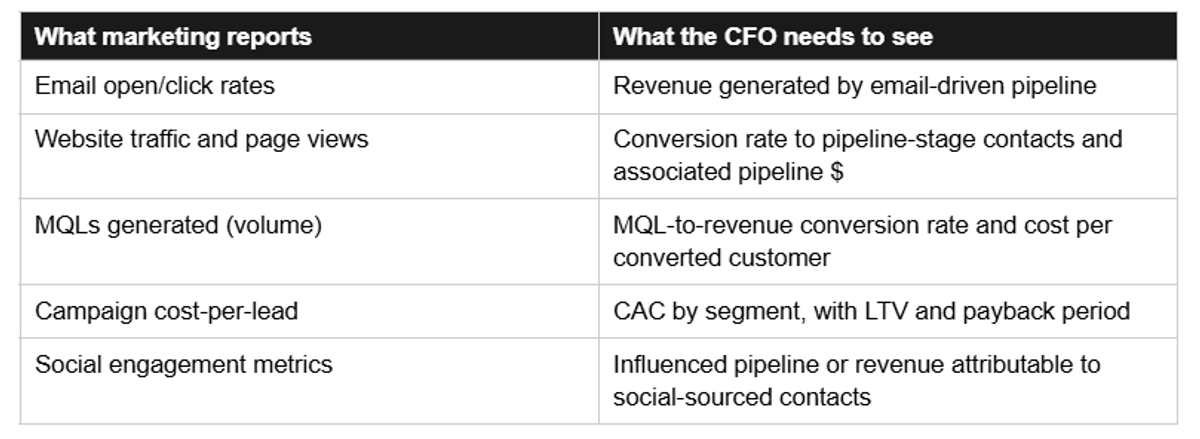
When your board sees a slide that leads with “45% email open rate” or “500 MQLs this month, up 30%,” they hear one thing: this team can’t connect their work to the P&L.
That’s accurate. If your metrics can’t answer “how much revenue did this create, and how fast does the spend come back,” you are running a cost center. Whether you call it demand gen or growth marketing doesn’t change the math.
What the CFO actually reads
CFOs and boards in PE-backed environments think in unit economics and capital efficiency. Their questions are blunt.
How much does it cost to acquire a customer? How much revenue does that customer produce? How fast does the acquisition spend pay back? How predictable is the pipeline feeding next quarter’s number?
That’s the entire framework. CAC by segment. LTV and LTV:CAC by cohort. CAC payback period. Marketing-sourced pipeline coverage against quarterly targets. Incremental revenue per incremental dollar of spend.
They don’t care about your open rate. They care whether the money came back, and when.
Where the friction actually lives
The misalignment isn’t abstract. It surfaces in specific, recurring patterns that compound over time.
The language gap. Marketing says “we generated 500 MQLs, up 30%.” The CFO asks “how many of those became revenue, and what did they cost?” Nobody in the room has an answer because the MQL definition doesn’t connect to the revenue definition. Different teams own different stages of the funnel. The definitions were never co-written with finance.
The time horizon problem. Marketing measures campaigns on weekly or monthly cycles. The CFO measures quarters. The board measures years. When marketing optimizes for lead volume this month while the CFO asks about ARR contribution this quarter, you’re having two conversations about two different time horizons. Neither person is wrong. But the disconnect leads to chronic underfunding of demand creation and overfunding of lower-funnel performance channels that look cheaper in the short term but don’t build contribution at scale.
The credibility deficit. Less than 25% of marketers say they and their CFO actually agree on metrics and budgets. That number should make marketing leaders uncomfortable. It doesn’t, because most of them don’t know it. Finance still describes marketing as “hard to measure,” and that perception isn’t unfair when marketing’s own dashboards don’t reflect how finance books revenue or defines pipeline. If your numbers live in a different system than the one your CFO uses, your numbers don’t exist to the people who control your budget.
The attribution trap. Instead of answering “did this spend produce revenue,” marketing teams get stuck debating first-touch versus multi-touch attribution models. The CFO doesn’t care which click gets credit. The CFO cares whether the aggregate spend produced a return. The attribution debate becomes a proxy war for accountability, and while marketing argues methodology, finance books the quarter without them.
The bridge metric set
The fix is a translation layer: a lean scorecard above your campaign metrics that converts marketing activity into the language of capital allocation. Something your CFO can read without asking you to define MQL for the fourth time.
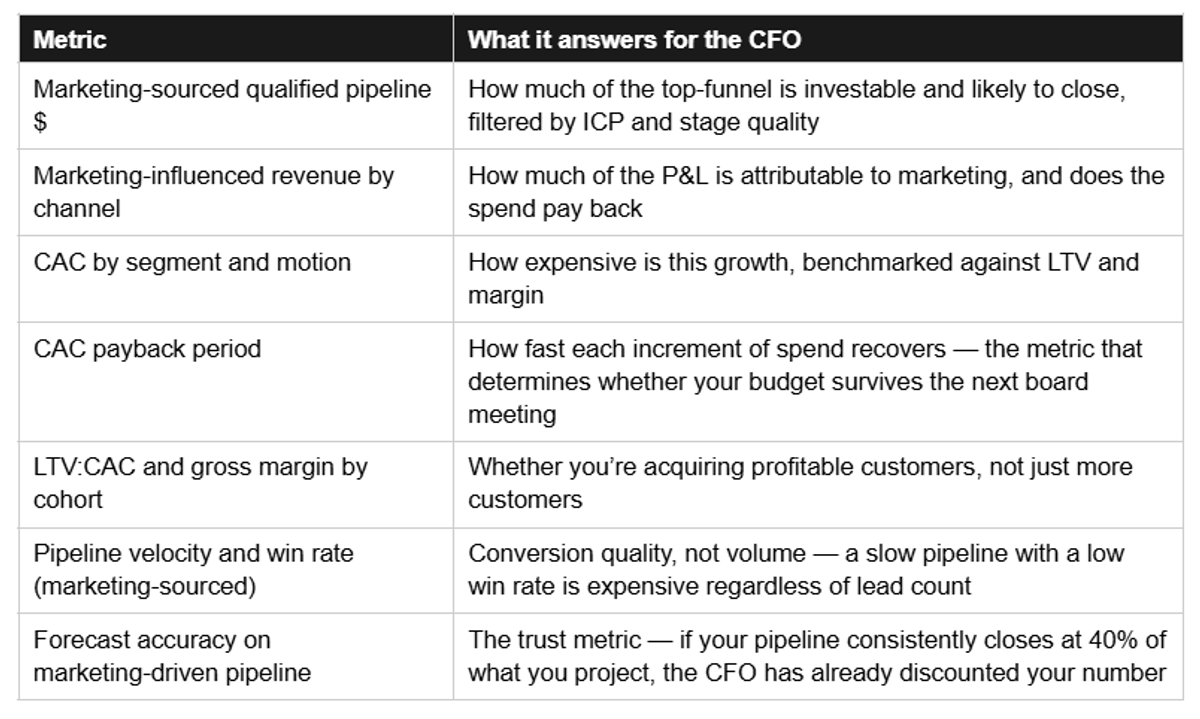
Two points worth sitting with. The forecast accuracy line is where institutional credibility lives. Bad forecasts destroy trust faster than bad results do. And LTV:CAC is the metric most marketing teams skip entirely, which means nobody is asking whether the customers being acquired are actually profitable at the unit level.
What to say instead
The translation is mechanical. Replace activity language with capital-allocation language. Same work. Different frame.
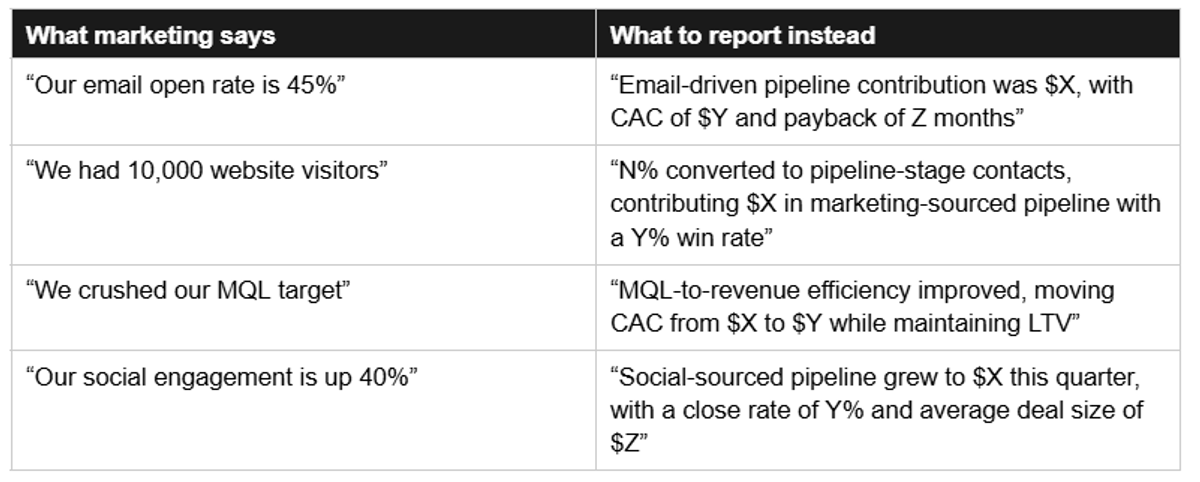
The CFO can now evaluate marketing as an investment with a return instead of an expense with an open rate. That distinction is the difference between getting budget expanded and getting budget interrogated.
How to build this into your operating rhythm
Four moves. None require new technology.
Co-write your definitions.Sit down with sales, RevOps, and the CFO’s team. Define lead, MQL, SQL, opportunity, and pipeline in shared language. If marketing’s “qualified” doesn’t match finance’s “bookable,” your attribution will never be credible. This step is tedious and politically uncomfortable, which is why most organizations skip it. That’s also why most organizations have this problem.
Build one pipeline dashboard. Show marketing-sourced pipeline in the same structure finance uses: by stage, by quarter, by cohort, by ICP segment. If marketing’s pipeline data lives in a different system or uses different stage definitions than finance, it’s invisible to the people who write the checks.
Lead your reports with the CFO slide. Revenue contribution, CAC, LTV:CAC, payback period, pipeline coverage. Page one. Channel performance and campaign detail go in the appendix. Most marketing teams invert this. They lead with what they’re proud of and bury what the board actually needs. Flip it.
Run quarterly capital-allocation reviews with the CFO. Treat your marketing budget like a portfolio of investments. Each program has a CAC and an incremental ARR projection. Fund or cut based on unit economics, not engagement scores. This is how the CFO already thinks about every other line item. Marketing should be no different.
The real cost of the gap
When marketing can’t answer “if we add $500K next quarter, how much incremental ARR and payback can you project,” the budget conversation turns adversarial. The CFO sees a cost line with no return model. The board sees a team that talks about activity when they asked about outcomes. Marketing gets managed as a headcount problem instead of a capital-allocation decision.
Your strategy might be right. Your campaigns might be producing exactly the results the business needs. But if the metrics don’t connect to the financial model, the work is invisible to the people who fund it.
Stop reporting campaigns. Start reporting unit economics. The CFO is already doing the math. The question is whether you’re in the equation or outside it.